Medusa: From Monster to Symbol of Female Power

Thomas L. Miller
Historian & Writer
In Homer and Hesiod, Medusa is simply a monster, one of three Gorgon sisters born to the sea deities Phorcys and Ceto, with snakes for hair whose gaze turns men to stone. She is presented without backstory, without sympathy, and without complexity. She is a danger to be overcome, and Perseus overcomes her. This is the Medusa of the archaic period: a creature from the dangerous margins of the world, like so many others in early Greek mythology.
The transformation of Medusa's story happened in the Roman period, most powerfully in Ovid's Metamorphoses (8 CE). Ovid added a crucial element absent from earlier sources: Medusa was once a beautiful mortal woman, priestess of Athena's temple, who was raped by Poseidon in the goddess's sanctuary. Athena's response, turning Medusa into the snake-haired monster, strikes most modern readers as a horrifying victim-blaming. Ovid presents it ambiguously: it might be read as punishment, or it might be read as a kind of terrible protection, transforming a vulnerable woman into something that can never be violated again. Scholarly opinion is divided.
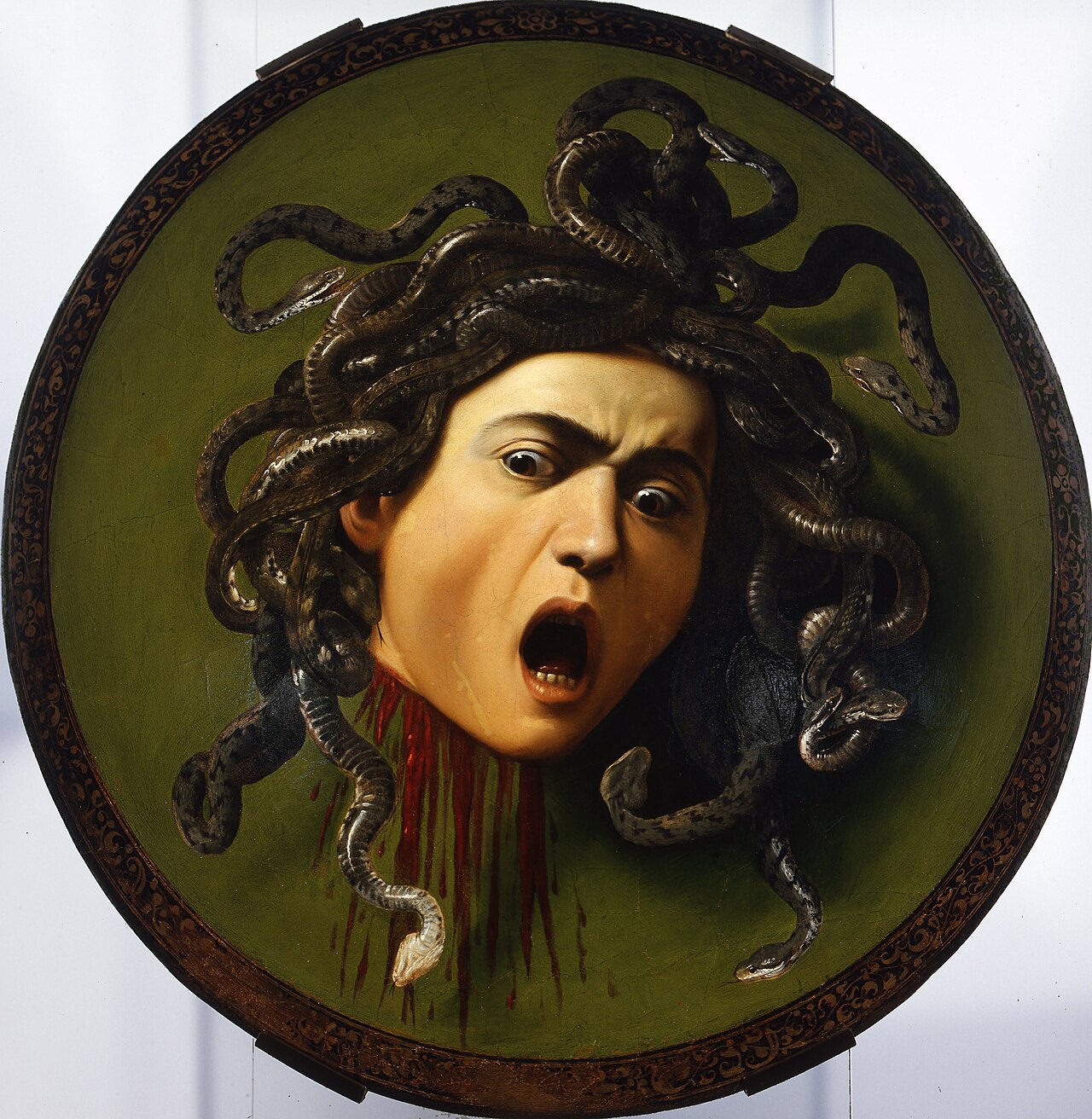
Caravaggio's 1597 painting of Medusa's severed head, screaming, eyes wide, blood spurting from the neck, captures the terrifying vitality of the monster while making her undeniably individualized and sympathetic. She is not simply a threat removed but a life ended, a face contorted in a last moment of consciousness. This image has become one of the most recognizable in Western art and has been extensively reinterpreted. The use of Medusa's image as an apotropaion, a protective symbol intended to ward off evil, is ancient: the Gorgoneion (Medusa's face) appears on temples, shields, coins, and amulets throughout the Greek and Roman world, turning her monstrousness into a tool of protection.
In contemporary culture, Medusa has been reclaimed as a complex symbol. Feminist scholars and artists have reread her story through the Ovid version, seeing in her a figure for what happens to women who are victimized and then blamed and transformed into threats in the cultural imagination. Luciano Garbati's 2008 sculpture "Medusa with the Head of Perseus," depicting Medusa holding the decapitated head of her killer, was installed opposite a New York courthouse in 2020 as a statement about gender-based violence and justice. Whatever the myth's "original meaning," a concept that is probably unanswerable given how the story has been reshaped across 2,700 years of telling and retelling, Medusa remains mythology's most contested figure, carrying within her a entire history of violence, power, and the politics of monstrosity.