Athenian Democracy: The Radical Experiment That Changed History

Thomas L. Miller
Historian & Writer
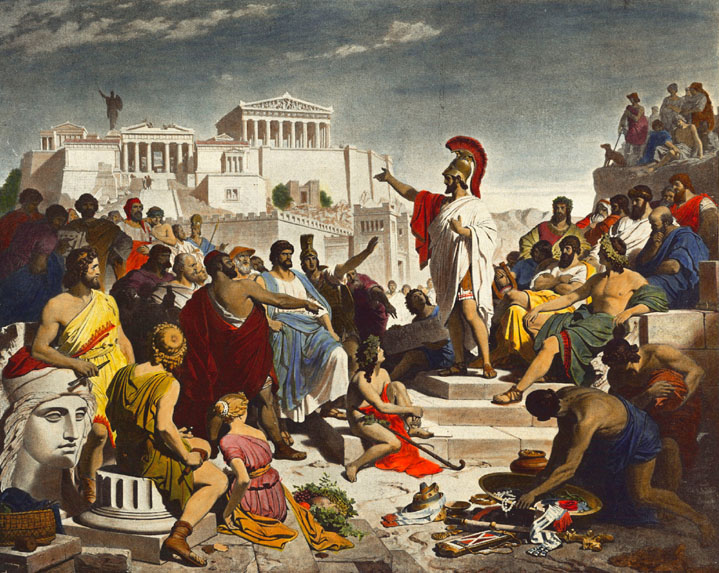
Athenian democracy was invented not in a single moment of inspiration but through a series of reforms spanning more than a century. The groundwork was laid by Solon in 594 BCE, who abolished debt slavery and restructured the political classes based on wealth rather than birth. The decisive step came with Cleisthenes in 507 BCE, who reorganized Athenian society into ten tribes (replacing the old four clan-based tribes) and created the Council of Five Hundred (Boule), a body of 500 citizens chosen by lot who set the agenda for the Assembly (Ekklesia). This is the moment scholars typically identify as the birth of democracy: demos (people) and kratos (power).
The Athenian democratic system at its height, after Ephialtes's reforms in 462 BCE and Pericles's subsequent developments, involved three main institutions. The Assembly (Ekklesia) was open to all adult male citizens and met approximately forty times per year on the Pnyx hill. Any citizen could speak and vote on legislation, war, and foreign policy. The Council of Five Hundred served as the executive committee, preparing business for the Assembly and administering day-to-day governance. The law courts (dikasteria) used large juries of citizens, sometimes hundreds of them, chosen by lot, who voted without deliberation by casting ballots.
The system was remarkable for its commitment to isegoria (equal right of speech) and isonomia (equality before the law). But its limitations are equally important to understand. The Athenian demos excluded women, slaves, and foreigners (metics), who together constituted the majority of the population. Even among citizens, participation required leisure time, which meant the wealthy and the poor who could not afford to leave their work were underrepresented in practice, though pay for jury service and later for assembly attendance was introduced to widen participation. The system was also capable of making terrible decisions: it condemned Socrates to death, launched the catastrophic Sicilian Expedition, and executed its own generals after the Battle of Arginusae in a moment of mass hysteria.
Despite its limitations and its eventual suppression (Athens lost its independence to Macedonia in 338 BCE and was never again a fully autonomous democracy), Athenian democracy left an intellectual legacy of incalculable importance. The debates within the Athenian Assembly, the speeches that survive from the law courts, and the philosophical tradition it produced, including Plato's critique of democracy and Aristotle's analysis of constitutions, provided the vocabulary and conceptual framework within which all subsequent democratic theory has operated. When the American Founders debated the form their new republic should take, they were explicitly in conversation with Athens. The experiment was brief, local, and exclusive, and it changed everything.